TRAVEL NARRATIVE

STRANDED IN NEPAL DURING THE FIRST WAVE OF COVID-19
20 min read
I WAKE UP IN A HOTEL SUITE IN KATHMANDU, AND WHEN I TRY TO STRETCH IN BED, I FEEL SEVERE CRAMPS GRIPPING MY THIGHS. So I lie there paralyzed, alone with my eyes closed, remembering that I didn’t finish the journey. I had planned to climb Mera Peak, but after four days in the Himalayas traveling with an old sherpa friend named Pasang and a 19-year-old porter, I decided to quit and turn back. I believed the main reason was the heaviest pre-monsoon rains that I had ever experienced on any of my previous trips, but there was another reason I was trying to ignore. The day I left, Spain declared a state of alarm over COVID-19. For the first time, the people I loved back home were at greater risk than I was in the mountains, and I I would be walking for weeks without hearing from them.
Retracing our steps took us several days, and at one point, we saw other trekkers suddenly turning around and heading back to Lukla airport. Pasang managed to book me a ticket on another airline, but it turned out to be the last scheduled flight out of Lukla, they had to stay behind. Noticing my unease, he insisted that I shouldn’t worry as they could walk to Kathmandu much faster without me. Information circulating among the trekkers was confusing, but that flight turned out to be the last attempt to get people off the mountains. Two days earlier, European countries had urged their citizens to return home before closing their airspace. There was a sense of trepidation among the 20 people boarding the small aircraft as the propellers roared. The plane sped down Lukla’s sharply sloping, almost toboggan-shaped runway, and someone cried, “Woohoo!” But when it began shaking violently in every direction, no one made another sound. During that flight, I learned that just before turbulence, cold draft can slip into the cabin and remind you how fragile it all is.
2
AS AN EU CITIZEN, THEY CAN'T DENY ME ENTRY TO THE EU. My flight to Spain is still three weeks away, so it is still scheduled, Spain’s lockdown is supposed to last only two weeks, and there are still no Covid-19 cases in Kathmandu. But in the meantime, Spain has quickly become one of the most dangerous places to return to. Following the advice on the Spanish Foreign Ministry website, I notify the embassy that I am in Kathmandu, but I choose to stay.
I'm staying in an old Newari hotel, and thanks to a friend, I can stay in a suite for very little money. I’m often the only guest in the east wing and rarely see anyone else; it feels like having my own apartment. I adore the Tibetan decor set within the partially decaying Hindu architecture. The pagoda roofs, the intricate courtyards and the clay altars half-hidden among the lush vegetation in the garden make me feel as though I am wandering through the ruins of a temple.
I feel as though I am living in what Tibetan Buddhists call the bardo, an in-between, dreamlike state in which there is no coronavirus. But my illusion is shattered when I wake up on the 24th and see the staff quickly packing everything to leave. The government has imposed a nationwide lockdown without warning after a Nepali student who had returned from France tested positive. Hotels close around Kathmandu, and tourists have to leave, not knowing where to go.
The staff cannot answer any of my anxious questions. They tell me they will shut down in a few hours, but I can stay because they know me. They feel for me. Some give me their phone numbers and assure me the lockdown will last only a week. The hotel manager lives in an adjacent building opposite the old wing, and the gatekeeper will also come every day. I call Pasang, and we talk in disbelief. How is this possible after just one new case and without any warning? “Maybe our government is lying to us,” he says.
I know, the Nepalis don't believe a word their government says anymore. “We don’t have a democracy”, a group of Thakali caravan drivers had told me in 2016 in Upper Mustang, “We have a demon-crazy.”
Although the staff tell me not to go out, I rush into the streets out of curiosity. As I turn the corner, the scene is surreal. A large group of locals hurries to buy food at a small grocery shop. Opposite the store, the last flames of a bonfire are still burning; the owners have burned the cardboard boxes used to transport the food. Behind them, the usually crowded Bishnumati Bridge is now without a soul in sight.
I’m far away from the tourist center, where the locals don’t speak English, so I have to lean over the counter, point to what I want and keep trying until someone understands me and translates. All I get is a tube of Pringles, biscuits and all the bottles of water I can fit in my rucksack. Even the water is past its expiration date.
But I can consider myself fortunate to have turned back when I did. Nepal also closes its airspace, and many of the travelers I saw in the mountains are trapped, waiting for rescue helicopters and government aid for food and shelter.
Nepal’s prime minister, K.P. Sharma Oli, is recovering from a second kidney transplant, and the country is acutely aware of how poorly equipped it is to fight an epidemic. Nepal began rolling out free basic healthcare after the war ended in 2006, but the hospital system is hampered by poor facilities and shortages of trained personnel. In the Kathmandu Valley, there is roughly one doctor for every 850 people; some rural areas do not even have clinics.
In a country where political corruption is endemic, the Health Ministry is accused early in the lockdown of taking kickbacks in the purchase of Chinese personal protective equipment and testing kits, causing delays and resulting in useless testing machines.

The government tries to emulate measures adopted by developed countries, believing that a lockdown imposed before community transmission, combined with testing and contact tracing, is the only answer. But beyond tourism, Nepal depends heavily on remittances, and some four million Nepalis are in India.
As the tragedy unfolds there, Nepal unconstitutionally bars its own citizens from returning. Fearing hunger more than disease, many risk their lives crossing mountains and rivers along the porous border.
Two days after the lockdown begins, a woman named Eva from the Spanish Embassy adds me to a WhatsApp group with other stranded Spanish travelers, who have managed to gather in one of the guesthouses the government has allowed to remain open. She announces dramatically that they are doing everything they can to get us onto one of the European repatriation flights bound for Paris or Frankfurt. From there, we will have to find our own way home. No help. Enraged and puzzled, people start complaining, arguing that we could end up stranded in a European city with all the hotels closed. She writes that if we stay, we will be dumped onto the streets, that food will soon run short because the borders are closed, and that it will only be a matter of time before we all get sick with COVID-19.
Everyone starts writing at once. A seventy-year-old woman complains, and Eva immediately blocks her, explaining that this should serve as a warning to the rest of us. We are there only to listen.
I’m shocked by her sadism and the counterproductive way she tries to spread panic, as though lockdown and border closure were the same thing. Our real problem is that Spain has no embassy in Nepal. The embassy responsible for Nepal is based in Ind ia and also covers Bhutan and Sri Lanka. Nobody expected all those countries to face consular emergencies at once. They are overwhelmed and want to get rid of us by having someone else send us home, so we don’t complain publicly. Her message is nothing but talk of riots and locals wielding machetes, enough to scare the hell out of any tourist.
I lived in Munich for many years, but no friend could travel north to pick me up. I have family in Madrid, but how could I ask them to take me in after I had passed through two or three different airports, when they had been in isolation for weeks? The other travelers start considering the possibility of getting an embassy permit and hiring a car once they reach Europe, but my risk of being stranded in an airport for days trying to get back to the Canary Islands is much higher.
That night I stay awake. There is a window as large as my bed. I stare at the moon’s mountainous surface, the same way I do outside my tent when altitude prevents me from sleeping at base camp. I watch the starless night fade into pre-monsoon clouds and refuse to sign a contract I haven’t been allowed to read first. The world is changing quickly, and everybody is improvising; I must base my decision on what I know today.
There is something else, an overwhelming feeling: every traveler dreams of staying when everybody else leaves.
So I stay, but I promise myself that, whatever happens, I cannot afford to get sick here.
3
FOOD AND WATER ARE MY BIGGEST WORRY. There is no public transportation, and only small grocery stores can remain open because their glass counters block the entrance, allowing customers to be served from outside. The suite is spacious, but I don't have a kitchen. I don't want to ask for favors, even though all my sherpa friends call me to say they are willing to break the lockdown, pick me up on their motorbikes and take me into their homes. After all, self-reliance is one of the reasons I travel alone. I can’t be a burden to others, so I tell myself that this deprivation is a chance to prove the strength I could not demonstrate this time in the mountains.
Everything remains frighteningly empty at the beginning. My diet consists of tuna sandwiches, milk and yogurt that I buy from a shop around the corner. I use my wool undershirts to clean the room and share the suite and the tuna with a semi-feral tabby cat the gatekeeper used to feed, who was always around the garden. I don’t think it is a coincidence that she is female, and I name her Mera, after the 21,000-foot mountain I had planned to climb. Mera presses herself against me in the dark when the nightly rainstorms begin.
After I tell the hotel manager what I’m eating, I find a few cans of sardines and some avocados on the doormat outside my room, but soon I realize I need to venture farther.
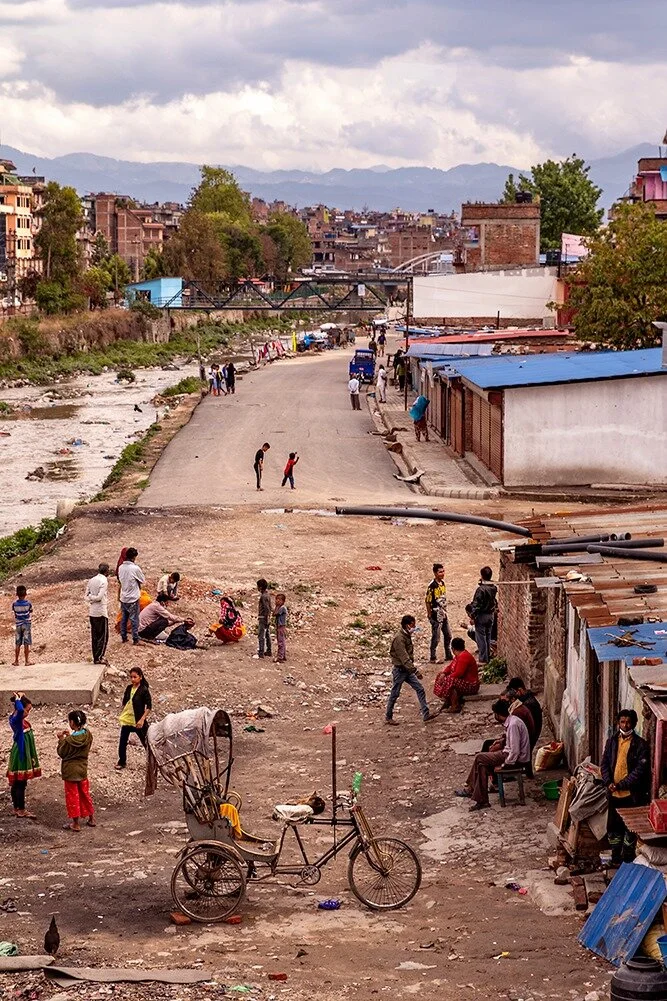
The first thing I see is the slums below the Bishnumati Bridge. A man squatting on a platform by the river cuts his son’s hair while the family gathers around them. The elders sit on benches near an abandoned rickshaw cart. Children play with balls and chickens. Nobody wears a mask. “The beloved river of Vishnu” is now a landfill that the government has commissioned several times to clean up, but no one, not even the police patrolling the bridge above in open trucks, seems to notice the Dalits, the “untouchables,” living in rooms made of corrugated cement sheets. The river acts as a thin boundary between the families confined to the left and people who have been socially isolated for years to the right.
My hotel is far from the usual tourist bustle, so now I have to walk up and down the ubiquitous slopes of this Himalayan city in the afternoon, during the two hours when people are allowed out to buy food, just as the rain begins to pour down. I wear my mountain wind jacket, cover my nose and mouth with the wool balaclava I wear in the mountains, tuck my camera under my arm to protect it from the rain, and carry my rucksack, hoping to fill it with enough food and water for several days.I sometimes duck to avoid the tangled, rain-soaked wires hanging from utility poles and try to remember every pharmacy I pass; they are the only places that are always open and sell water, too. The police officers I encounter along the way wear camouflage uniforms and carry large bamboo batons called lathis, which they use to discourage people from sitting on their doorsteps to chat. They patrol the streets in open trucks and use extendable claws, normally used to recover bodies from the water, to grab and push those defying the lockdown.
Within a couple of weeks, grocery shops are surrounded by stray dogs waiting for the sellers to give them some food. Accustomed to being fed by travelers, they now rest their heads on the sidewalk, too weak to sit. People’s suffering remains hidden indoors, but I will never forget the bewilderment in the animals’ eyes. In Thamel, the tourist hub, the scent of incense and music no longer spills out of the shops and into the streets.On some main roads, piles of rubble accumulate, and construction workers have left behind their rudimentary wooden equipment as if some sudden tragedy had forced them to run for their lives.
Many think the lockdown extension is a way to ensure that no one will celebrate the spring festivals or the New Year. The massive chariot-pulling processions carrying Buddhist and Hindu deities, as well as the tongue-piercing festival, seem too Tantric and visceral for an epidemic, too dangerous; priests therefore perform the pujas alone in the temples.All attention turns to the cremation grounds at Pashupatinath Temple. Although the temple is closed to the public, a rising number of bodies cannot remain hidden for long. The country has seen fewer than ten cases of COVID-19 for almost a month, and we all begin to adapt to one of the strictest lockdowns in the world. But on April 21, newspapers in Kathmandu announce that community transmission has begun after eleven Indians who had crossed the border were found hiding in a mosque in the southern district of Udayapur. Now everybody knows the airports will remain close for months. Evacuation flights stopped weeks ago. I remember the silence at home when I call with the news.
In the Narendra Modi era, the Muslim community has been scapegoated in India, accused of spreading COVID-19 through religious gatherings. Many of the migrant workers who sustain Nepal are denied the right to return and now crowd the border. The improvised quarantine facilities in rural areas are traps where people become infected, and Nepalis confined for a month feel that all their sacrifices have been for nothing. An incompetent government has sealed their fate, so they begin finding their own ways out.


4
SAHEEL IS A 26-YEAR-OLD MADHESI, A MUSLIM NEPALI OF INDIAN HERITAGE, whom I meet in Thamel. He moved from the Terai plains to Kathmandu to work in one of Thamel’s thangka shops. I’m taking photographs there when I hear people whistling to one another. Soon I realize that some men are following me. I instinctively grab my camera; the leather strap is around my neck, and I worry that if they pull on it, they could drag me along the street.
At that moment, Saheel steps forward and introduces himself. He is quick-witted, has crow-black hair, and wears the same cloth mask most people wear in this heavily polluted city. Judging by his eyes, I imagine he has a beautiful face. He asks me if there is anything I need. “Do you know if there are any restaurants open?” I ask. He guides me away from the main streets and into narrow alleys where there is no one. Following a stranger whose face is half-covered through deserted narrow alleys is well beyond my solo travel protocol. I follow him anyway, but slip my hand into my pocket and grip the brass whistle I always carry in the mountains in case of an accident, since I prefer walking alone. He takes me to a pub where only three local men are sitting and asks me what I want to eat. “Whatever you have,” I say, realizing that the pub is officially closed and that he is asking a friend for a favor so we can get something to eat. They both go into the kitchen to discuss it, but Saheel comes back disappointed, saying we’d better find another place.
We talk all the way there, and he takes something resembling a passport from his pocket and shows me a picture of his two-year-old baby inside. I notice the kohl painted around the baby’s eyes, meant to protect children from the evil eye. Saheel tells me he has been out of work for a month in a country with virtually no unemployment safety net and is doing whatever he can to survive. I know what he wants. It is something no one has asked me for since my first trips to Nepal during the final years of the decade-long civil war.
Some Nepalis used to ask foreigners to buy them a can of powdered baby formula that would last a family with one child for a month and cost $17, roughly a week’s salary in Nepal. Most of the time, they would take it back to the store, return it and get the money back.

Saheel takes me to another narrow alley where people, mainly Nepalis, are crowded into lines on both sides. Two Chinese women in hazmat suits guide them to a water drum to wash their hands before going upstairs to sit on a balcony and eat. We ask one of the women if it is possible to pay for the food, but she shakes her head, so I tell Saheel I don’t want to eat there. Before I leave, I turn to take a photo, and an angry man waiting in line turns around and shouts at me not to do it.
I put the camera down, but as soon as he returns to the line, Saheel tells me, “Take the photo, I’m here.” I hesitate for a second, and this time the man strides aggressively toward Saheel. I shout to Saheel that it isn’t worth it, and we leave quickly. But I understand better what people in that alley are feeling the next time I pass by and find several stranded Chinese tourists taking pictures with their cell phones. One of them is using a selfie stick to film himself as he explains why people go there.
We turn around, and I come across a large group of foreigners slowly walking together toward the restaurant. A six-foot-tall man at the front seems to be leading them. There are about 15 of them, all wearing cloth masks and dusty trekking clothes. Since the lockdown began, I haven’t seen any other foreigners, but I know there were 10,000 travelers in the country when it started and that not all of them were able to leave. I’m not surprised by their appearance.They look like ghosts and seem defeated. They came to a poor country as privileged tourists and now depend on the country’s food relief program.
Farther ahead, a man in his sixties approaches Saheel in tears, showing him his injured hand. They speak in Nepali, but Saheel is protective again and tells me to hurry up. He tells me someone has stolen the man’s money and hurt his hand. I ask what happened, but he shrugs. “He is on drugs, you know? Glue.” It seems shop owners used to keep people like him away, but Thamel has a different meaning right now.
Eventually, Saheel has the idea of taking me to a bakery he knows is open. A little farther away, there is another Thamel, one for the locals. In the narrow alleys on its outskirts, women squat elbow to elbow in the street selling vegetables. If what I long for is something warm to eat, the bakery makes small, hard-crust pizzas and heats them in the oven. It is better than nothing. I buy him the baby formula, and at a pharmacy he calls his brother Nakir, who comes to pick me up in his rickshaw. Saheel enters his phone number into my cellphone and tells me he is always in Thamel, trying to survive, and that he will help me with anything I need.
On the ride back to the hotel, Nakir turns around and offers to sell me hashish. It is a typical offer, as Kathmandu still evokes the mystique of the hippie trail in so many ways. I politely refuse and assume Saheel knew he would offer it to me. We are going home at bicycle speed along an empty road, yet I have never gone so fast in a rickshaw. Nothing remains of the chaos that makes South Asian cities what they are. “No cows, uh? No people,” he shouts. The more I laugh with excitement, the more encouraged Nakir becomes to pedal faster.
I meet Saheel again a few days later. This time there are even more men controlling the area and asking me what I am looking for. When I ask for a supermarket, some lead me a few steps farther and knock on a steel rolling door so that someone inside can open it. When I come back out, others approach me. “Do you want shawls, trekking boots, a haircut, didi?” I can see the feet of shop owners beneath partially raised doors, and from time to time I hear repeated whistles traveling along the streets. Sometimes they warn others that the police are coming; at other times, that a new foreigner is looking for something. Rickshaw drivers also follow the few foreigners they see, paradoxically offering tours of deserted places.
Saheel wants me to take photos of what is happening in his country and leads me to the back of the Annapurna Hotel, where about 200 Nepalis are waiting in line for food. On the way there, I see many children. Saheel gestures to one wearing his mask on his chin to pull it up properly. The children don’t seem embarrassed. They walk resolutely with their friends and treat it as an adventure, but I also see some flinch as if they were about to be shot when a police officer points a handheld thermometer at them to take their temperature. A blond Western woman hands out food packages one by one, her hair damp and her surgical gloves slick with sweat. She runs back and forth, looking exhausted, and in less than ten minutes, she shouts, “Finito!” The food is gone; those still waiting will have to come earlier the next day. The line simply dissolves. Without protest, people turn around and go home. Business as usual.


5
SEVEN WEEKS HAVE PASSED SINCE I ARRIVED. From the rooftop, the Himalayan range is visible in the distance for the first time in decades. Every day I wake up before dawn to the sound of Asian koels calling wildly to one another and leave bananas on the balcony for the gray langur monkeys that roam the garden paths before the gatekeeper arrives. I have stopped calculating when I might be able to return home. One evening, I’m sitting on a step of one of the porches overlooking the garden. I’m surrounded by mango trees, weeping willows and star jasmine. The lights along the garden paths are on just for me, and above them are sculptures of dancing Hindu gods and goddesses. Tiny Mera is playing around and, from time to time, she stops and looks at me, like a child checking that a parent is still there. Although I’m used to traveling alone, I had taken an entire safety net for granted until it disappeared overnight. I draw on the skills I learned in the Himalaya: self-confidence, alertness, acceptance. Now I listen to the voice beating inside me. I look around and finally feel it, the sense of awe that had eluded me in the mountains, and I realize I have been happy throughout this journey.
Then an email from the French embassy arrives unexpectedly. They urge me to go to the embassy and get a ticket for one last repatriation flight leaving that Saturday. My first reaction is to delete it without telling anyone, but Spain has already flattened the curve while the worst is still ahead in Nepal. I feel like a freeskier who has been waiting at the top of a mountain for the right second to jump.
I go to Thamel one last time to say goodbye to Saheel. I see the disappointment in his eyes. We can’t shake hands, but instead he pulls his mask down to his chin. Only then do I see the characteristic discoloration around his nose and mouth, his front teeth gone but the roots still there, all the signs I associate with a glue sniffer, someone I would never have dared to talk to. I’m dazed and hurt. Gasping for air, I whisper, “I don’t want to go,” fighting back the tears I have held in for two months. I fear the uncertainty of being stranded in France, I fear getting sick, but most of all, I fear returning to a country that has changed while I was away.
“You’ll be back soon, you’ll see,” Saheel says. I nod with a sad smile he can’t see and wish him the best. Then I turn away and leave.