Blog

INTERVIEW WITH CARL HOFFMAN

Portrait of author Carl Hoffman

© Richard Kerris

“I DIDN'T WANT TO CHANGE THE WORLD. I JUST WANTED TO TASTE IT, SEE IT, SMELL IT, AND BRING THOSE STORIES HOME.

13 min read

For over thirty years, this acclaimed American author has not only explored every corners of the world, but also all the possibilities that travel narrative has to offer, from in-depth investigative journalism to the obsessions and deepest longings of the people he portrays. His tanned skin reveals his physicality, his love for the sea and the outdoors, and his preference for wearing white shirts reminds me of the classic reporter who travels mainly to listen. Incisive, evocative, committed. Reading Carl Hoffman is to remember Ryszard Kapuściński’s words, “A journalist can’t be a cynic, can’t forget his humanity and that of the people he meets.”

VANESSA MARTÍN QUINTANA: You were born in Washington in 1960, and your father, Burt Hoffman, worked as a journalist for The Washington Star. I can’t imagine anyone growing up in that time, place, and environment and not wanting to be a journalist. How would you describe your upbringing? 

CARL HOFFMAN: My father worked mainly as an editor and I remember going to The Washington Star newsroom as a child. There were always journalists at home too. My mother was a huge reader so I grew up in a house full of books. My father always gave me the literary journalists, such as John McPhee or The New Yorker people, and my mother gave me novels. So it was inevitable, I guess. But also, my parents divorced when I was very young. My mother was a severe alcoholic and there was a lot of fighting, and screaming, so I got into this kind of literature about real people living fantasy lives, you know, T.E. Lawrence’s Seven Pillars of Wisdom or Wilfred Thesiger’s Arabian Sands. Those magnificent people who crossed borders into new worlds to gain knowledge and wisdom they brought home. They were my way of escaping. That is what stories are about: escapes and inspiration.

That explains why, from the very beginning, you focused on travel writing and wrote about places such as Sudan, Afghanistan, and the Gobi Desert. What made you choose a life outside a newsroom?

I never wanted to be a reporter. My parents were super political, and my dad eventually left The Star to work in politics directly as part of the press section for Sargent Shriver, the Democratic vice-presidential nominee, during the 1972 Presidential Campaign. After that, he worked on Capitol Hill for Tip O’Neill, a former speaker of the U.S House of Representatives. But I never thought I wanted to change the world. Instead, I wanted to taste it, see it, smell it, and bring those stories home.

After graduating in Social Thought and Political Economy, I met a woman, and we went on a journey around Europe, then Egypt, Israel, China, and from there took the Trans-Siberian from Beijing to Moscow. It changed my life. And when I came back, all I did was write about that journey and try to sell it. I sold my first story to The Boston Globe. It was about sailing up the Nile in a traditional felucca and I got $150. I didn’t have credentials. I had never taken a class in Journalism. All I wanted was to be V.S. Naipaul, Paul Theroux… and slowly, for many years, I made my way into magazines. 

You wrote a book titled The Lunatic Express: discovering the world via its most dangerous buses, boats, trains, and planes. At first, I thought it was quite a masochistic premise for a man looking for trouble, but it is full of joy and struggle often happens in between journeys, at home. It is also your first venture into travel memoir following your debut with a book titled Hunting Warbirds: the obsessive quest for the lost aircraft of WWII…

Of course, writing a book was the big goal, and Hunting Warbirds just came out of a series of magazine stories that I had done about those crazy guys who tried to fly those B-29 bombers from the WWII era out of Greenland. It was 2001, and I felt it was a big accomplishment, but nobody read or reviewed it, although it boosted my career in magazines. I started traveling all over the world to write pieces for Outside, National Geographic Traveler, and also Wired, where I became a contributed editor on contract.

Then, in 2007, I wrote a story for Outside magazine about an American named Tim Roman, who was a jet pilot in the DRC. At that time, two Kabilas ruled the region. The father took over after the war against Mobutu. Later, he was assassinated and his son took over. Tim Roman helped the Kabilas win that war and in exchange got mining concessions, built roads, and started an airline. He became this wild Kurtzian figure. I spent a couple of weeks with him in Kinshasa and traveled around. At some point, we flew the Nigerian Ambassador and the Congolese minister of finance to Abuja in a tiny plane, and I had to pretend I was the flight attendant! We got stuck there... It was a wild, crazy story, and my editor loved it. So he called up one day, and I suddenly came up with the idea, “What if I flew around the world on the most dangerous airlines?” To which he replied, “What about traveling around the world in the most dangerous everything?” My reaction was, “That is not a magazine story, that is a book.” 

I got my first big book contract. It was my dream come true, and at the same time, my marriage of twenty-five years, and my life were falling apart. That journey of five months and 50,000 miles coincided with all those changes. The result is that Lunatic Express became deeper, and had a lot more soul to it than Hunting Warbirds, which was a pretty straightforward journalistic book. Lunatic Express became one of the ten best books of 2010 by The Wall Street Journal.  

In 2014, you published Savage Harvest: a tale of cannibals, colonialism and Michael Rockefeller’s tragic quest for primitive art, in which you retrace Michael Rockefeller’s steps to understand his mysterious disappearance. The book, half investigative journalism and half travel memoir, became a bestseller. You said after the first trip to New Guinea, you realized you would have to risk much more, both financially and physically, and go back and immerse yourself completely. Why did you feel it would not work otherwise?

 I had always been fascinated by the story of Michael Rockefeller's disappearance in New Guinea in 1961. He was a very famous person and the son of the governor of New York at that time. When I first researched online, I realized there were only a few early references, nothing substantive in 55 years. I thought that maybe the time had come and people would be willing to speak. I hired a researcher from Amsterdam. He went into the archives and immediately found details, real data that pointed to Rockefeller being killed and consumed by the Asmat tribe. But this was only the official version. I had to find out if it was true. So, I went to New Guinea for two months, made two trips to the village where the story happened and I really hit a wall. They weren’t speaking to me. Asmat is a difficult place, a 10,000 square-mile swamp with no roads around. When I came back, I tried to write with the material I had, but I realized that I had committed the cardinal sin in journalism: to parachute into someplace and expect people to tell me their darkest secrets and everything about their most important rituals and culture, and do it through an interpreter. To answer your question simply: I had not given enough, not committed enough.

 There, I had hired an interpreter and his assistant, the boat guy and his assistant, the cook… I needed seven or eight people. I realized that I had to go back to Asmat alone and speak the language myself. I found an Indonesian woman in the States and took a seven-month crash course. 

 Afterwards, I came back and approached things differently. I didn’t ask questions about Rockefeller. I lived in a house in the Asmat village with an elder named Kokai. I smoked with them, drank coffee with them, listened, watched, and let people get to know me and take care of me. And when I started to ask questions, they were very different from the ones that I had asked before.

Michael Rockefeller working in Papua, New Guinea, in 1961

Michael Rockefeller working in Papua, New Guinea in 1961. © President and Fellows of Harvard University/ Peabody Museum

 Was your love for Indonesia a consequence of that experience, or was it one more reason to write that story?

My father lived in Jakarta in the late ‘80s, and I used to visit him. At that time, I read Where the Spirits Dwell by Tobias Schneebaum, and my fascination with the Asmat started. I had watched Robert Gardner’s documentary film Dead Birds, which Michael Rockefeller had worked on. It was released in 1963. That was the film that had brought both of them to the Baliem Valley and Wamena. Working on that film led Rockefeller to the Asmat. In those days, it was too hard to get to Papua and I didn’t have the money either, but I went to Borneo through the Mahakam river which lit my fire. And when I was writing Lunatic Express, I learned that crowded Indonesian ferries sailing across the archipelago had a long history of sinking, killing thousands over the years. So it became logical to make Indonesia part of that journey. 

So, I knew about Rockefeller and the Asmat because of those experiences, and that led me to travel there and learn the language. It is like you with the Himalaya. You keep coming back and you know more and more, and one new thing reinforces another.

I know how you opposed Trump and how vocal you were about his presidency, and in the middle of the chaotic Trump presidency, you decided to write a book about his followers. Liar’s Circus, which as the subtitle describes, is a strange and terrifying journey into the upside-down world of Trump’s MAGA rallies. So you approach the story the story much as you had approached your previous adventure books set in remote places. It seems to me those rallies were more dangerous and hostile than any tribe or jungle. How was that experience?

Going into the Trump rallies and inhabiting daily life with the most obsessive Trump supporters was like getting into the Heart of Darkness of my own country, but it never felt particularly dangerous. It is about a middle-aged white guy hanging out with middle-aged white guys. However, I admit it was physically demanding and emotionally draining. For instance, I spent fifty hours in a parking lot in Tupelo, Mississippi, to be the sixth person in line. I also spent days camping on chairs next to my car, sometimes in the cold or rain, and finally, listening to Trump is a terrible and exhausting experience itself. It was interesting to travel through my country speaking to all kinds of people without the language or cultural barriers.

 Afterwards, I came back and approached things differently. I didn’t ask questions about Rockefeller. I lived in a house in the Asmat village with an Elder named Kokai. I smoked with them, drank coffee with them, listened, watched, and let people get to know me and take care of me. And when I started to ask questions, they were very different from the ones that I had asked before.

Reading your books, I get a strong sense of your passion for travel, nature and spirituality. I know you are also an accomplished Ashtanga yogi. Why did you start practicing, and how has Ashtanga yoga influenced you?

I was raised as an atheist, but, you know, life becomes more complicated as you get older and experience grief and loss. You try to come to terms with it and find your place in the world. 

My experience with the Asmat became a defining moment for me. They were intrinsically spiritual and had such a complex religion, and although some are nominal Christians or Catholics, that is like a light veneer over deeply held spiritual practices. The traditional religions associated with hierarchies never interested me and threw me off. But seeing the Asmat drumming and singing for 24 hours straight all through the night was like a doorway for me. Seeing people untouched by the outside world hold such powerful and insightful beliefs made me understand those beliefs are intrinsic to the human soul. After that, I became interested in authors such as Joseph Campbell and read The Power of Myth and understood the universality of it all. 

However, my yoga practice is not part of that, to be honest. It is more physical. It keeps me strong and flexible. It is good, though, to have a daily practice that grounds you.

 You have just written your first novel. What is the story about?

The working title is Borderland, and it is about some of the themes we have talked about. There is this old cliché that says that everybody writes just the same book over and over again. My story is about borders: physical and mental, but also the imaginary ones. It is about distant lands and the impact of love, books, and stories. I think it also tells a bit about white Western hubris.

You told me once you didn’t enjoy reading travel memoirs so much anymore because you were too aware of their structure and narrative devices. How would you compare working on this novel to working on your previous books?

They are very different. Fiction is much harder. The books I had written were built on extensive investigative reporting. The more information, the more you can live the story, and then it all gets down to rearranging it, creating a structure and telling the story in an elegant way that moves the reader and allows you to put your finger on a kind of truth. Yet we all know there is nothing truer than fiction. Made-up stories are truer. Writing a novel from scratch means I will use what I have seen, read, said, and experienced, and assemble it differently. It requires a different way of thinking, and it is almost like lucid dreaming for hours on end. Writing some parts is like trying to tear off my skin, digging into a truth, admitting it, saying it. But there is also magic in it. You sit and describe a scene without having any plan, and when you look back later at what you came up with, the symbolism, for instance, can be striking.


KATHMANDU UNDER LOCKDOWN

TRAVEL NARRATIVE

cuarentena_4.jpg
STRANDED IN NEPAL DURING THE FIRST WAVE OF COVID-19

20 min read

I WAKE UP IN A HOTEL SUITE IN KATHMANDU, AND WHEN I TRY TO STRETCH IN BED, I FEEL SEVERE CRAMPS GRIPPING MY THIGHS. So I lie there paralyzed, alone with my eyes closed, remembering that I didn’t finish the journey. I had planned to climb Mera Peak, but after four days in the Himalayas traveling with an old sherpa friend named Pasang and a 19-year-old porter, I decided to quit and turn back. I believed the main reason was the heaviest pre-monsoon rains that I had ever experienced on any of my previous trips, but there was another reason I was trying to ignore. The day I left, Spain declared a state of alarm over COVID-19. For the first time, the people I loved back home were at greater risk than I was in the mountains, and I I would be walking for weeks without hearing from them.  

Retracing our steps took us several days, and at one point, we saw other trekkers suddenly turning around and heading back to Lukla airport. Pasang managed to book me a ticket on another airline, but it turned out to be the last scheduled flight out of Lukla, they had to stay behind. Noticing my unease, he insisted that I shouldn’t worry as they could walk to Kathmandu much faster without me. Information circulating among the trekkers was confusing, but that flight turned out to be the last attempt to get people off the mountains. Two days earlier, European countries had urged their citizens to return home before closing their airspace. There was a sense of trepidation among the 20 people boarding the small aircraft as the propellers roared. The plane sped down Lukla’s sharply sloping, almost toboggan-shaped runway, and someone cried, “Woohoo!” But when it began shaking violently in every direction, no one made another sound. During that flight, I learned that just before turbulence, cold draft can slip into the cabin and remind you how fragile it all is.

2

AS AN EU CITIZEN, THEY CAN'T DENY ME ENTRY TO THE EU. My flight to Spain is still three weeks away, so it is still scheduled, Spain’s lockdown is supposed to last only two weeks, and there are still no Covid-19 cases in Kathmandu. But in the meantime, Spain has quickly become one of the most dangerous places to return to. Following the advice on the Spanish Foreign Ministry website, I notify the embassy that I am in Kathmandu, but I choose to stay.

I'm staying in an old Newari hotel, and thanks to a friend, I can stay in a suite for very little money. I’m often the only guest in the east wing and rarely see anyone else; it feels like having my own apartment. I adore the Tibetan decor set within the partially decaying Hindu architecture. The pagoda roofs, the intricate courtyards and the clay altars half-hidden among the lush vegetation in the garden make me feel as though I am wandering through the ruins of a temple.

I feel as though I am living in what Tibetan Buddhists call the bardo, an in-between, dreamlike state in which there is no coronavirus. But my illusion is shattered when I wake up on the 24th and see the staff quickly packing everything to leave. The government has imposed a nationwide lockdown without warning after a Nepali student who had returned from France tested positive. Hotels close around Kathmandu, and tourists have to leave, not knowing where to go.

The staff cannot answer any of my anxious questions. They tell me they will shut down in a few hours, but I can stay because they know me. They feel for me. Some give me their phone numbers and assure me the lockdown will last only a week. The hotel manager lives in an adjacent building opposite the old wing, and the gatekeeper will also come every day. I call Pasang, and we talk in disbelief. How is this possible after just one new case and without any warning? “Maybe our government is lying to us,” he says.


I know, the Nepalis don't believe a word their government says anymore. “We don’t have a democracy”, a group of Thakali caravan drivers had told me in 2016 in Upper Mustang, “We have a demon-crazy.”


Although the staff tell me not to go out, I rush into the streets out of curiosity. As I turn the corner, the scene is surreal. A large group of locals hurries to buy food at a small grocery shop. Opposite the store, the last flames of a bonfire are still burning; the owners have burned the cardboard boxes used to transport the food. Behind them, the usually crowded Bishnumati Bridge is now without a soul in sight.

I’m far away from the tourist center, where the locals don’t speak English, so I have to lean over the counter, point to what I want and keep trying until someone understands me and translates. All I get is a tube of Pringles, biscuits and all the bottles of water I can fit in my rucksack. Even the water is past its expiration date.

But I can consider myself fortunate to have turned back when I did. Nepal also closes its airspace, and many of the travelers I saw in the mountains are trapped, waiting for rescue helicopters and government aid for food and shelter.

Nepal’s prime minister, K.P. Sharma Oli, is recovering from a second kidney transplant, and the country is acutely aware of how poorly equipped it is to fight an epidemic. Nepal began rolling out free basic healthcare after the war ended in 2006, but the hospital system is hampered by poor facilities and shortages of trained personnel. In the Kathmandu Valley, there is roughly one doctor for every 850 people; some rural areas do not even have clinics.

In a country where political corruption is endemic, the Health Ministry is accused early in the lockdown of taking kickbacks in the purchase of Chinese personal protective equipment and testing kits, causing delays and resulting in useless testing machines.

kathmandu_truck_provider_ko_1000.jpg

The government tries to emulate measures adopted by developed countries, believing that a lockdown imposed before community transmission, combined with testing and contact tracing, is the only answer. But beyond tourism, Nepal depends heavily on remittances, and some four million Nepalis are in India.

As the tragedy unfolds there, Nepal unconstitutionally bars its own citizens from returning. Fearing hunger more than disease, many risk their lives crossing mountains and rivers along the porous border.

Two days after the lockdown begins, a woman named Eva from the Spanish Embassy adds me to a WhatsApp group with other stranded Spanish travelers, who have managed to gather in one of the guesthouses the government has allowed to remain open. She announces dramatically that they are doing everything they can to get us onto one of the European repatriation flights bound for Paris or Frankfurt. From there, we will have to find our own way home. No help. Enraged and puzzled, people start complaining, arguing that we could end up stranded in a European city with all the hotels closed. She writes that if we stay, we will be dumped onto the streets, that food will soon run short because the borders are closed, and that it will only be a matter of time before we all get sick with COVID-19.

Everyone starts writing at once. A seventy-year-old woman complains, and Eva immediately blocks her, explaining that this should serve as a warning to the rest of us. We are there only to listen.

I’m shocked by her sadism and the counterproductive way she tries to spread panic, as though lockdown and border closure were the same thing. Our real problem is that Spain has no embassy in Nepal. The embassy responsible for Nepal is based in Ind ia and also covers Bhutan and Sri Lanka. Nobody expected all those countries to face consular emergencies at once. They are overwhelmed and want to get rid of us by having someone else send us home, so we don’t complain publicly. Her message is nothing but talk of riots and locals wielding machetes, enough to scare the hell out of any tourist.

I lived in Munich for many years, but no friend could travel north to pick me up. I have family in Madrid, but how could I ask them to take me in after I had passed through two or three different airports, when they had been in isolation for weeks? The other travelers start considering the possibility of getting an embassy permit and hiring a car once they reach Europe, but my risk of being stranded in an airport for days trying to get back to the Canary Islands is much higher.

That night I stay awake. There is a window as large as my bed. I stare at the moon’s mountainous surface, the same way I do outside my tent when altitude prevents me from sleeping at base camp. I watch the starless night fade into pre-monsoon clouds and refuse to sign a contract I haven’t been allowed to read first. The world is changing quickly, and everybody is improvising; I must base my decision on what I know today.

There is something else, an overwhelming feeling: every traveler dreams of staying when everybody else leaves.

So I stay, but I promise myself that, whatever happens, I cannot afford to get sick here.

3

FOOD AND WATER ARE MY BIGGEST WORRY. There is no public transportation, and only small grocery stores can remain open because their glass counters block the entrance, allowing customers to be served from outside. The suite is spacious, but I don't have a kitchen. I don't want to ask for favors, even though all my sherpa friends call me to say they are willing to break the lockdown, pick me up on their motorbikes and take me into their homes. After all, self-reliance is one of the reasons I travel alone. I can’t be a burden to others, so I tell myself that this deprivation is a chance to prove the strength I could not demonstrate this time in the mountains.

kathmandu_bridge_blog.jpg

Everything remains frighteningly empty at the beginning. My diet consists of tuna sandwiches, milk and yogurt that I buy from a shop around the corner. I use my wool undershirts to clean the room and share the suite and the tuna with a semi-feral tabby cat the gatekeeper used to feed, who was always around the garden. I don’t think it is a coincidence that she is female, and I name her Mera, after the 21,000-foot mountain I had planned to climb. Mera presses herself against me in the dark when the nightly rainstorms begin.

After I tell the hotel manager what I’m eating, I find a few cans of sardines and some avocados on the doormat outside my room, but soon I realize I need to venture farther.

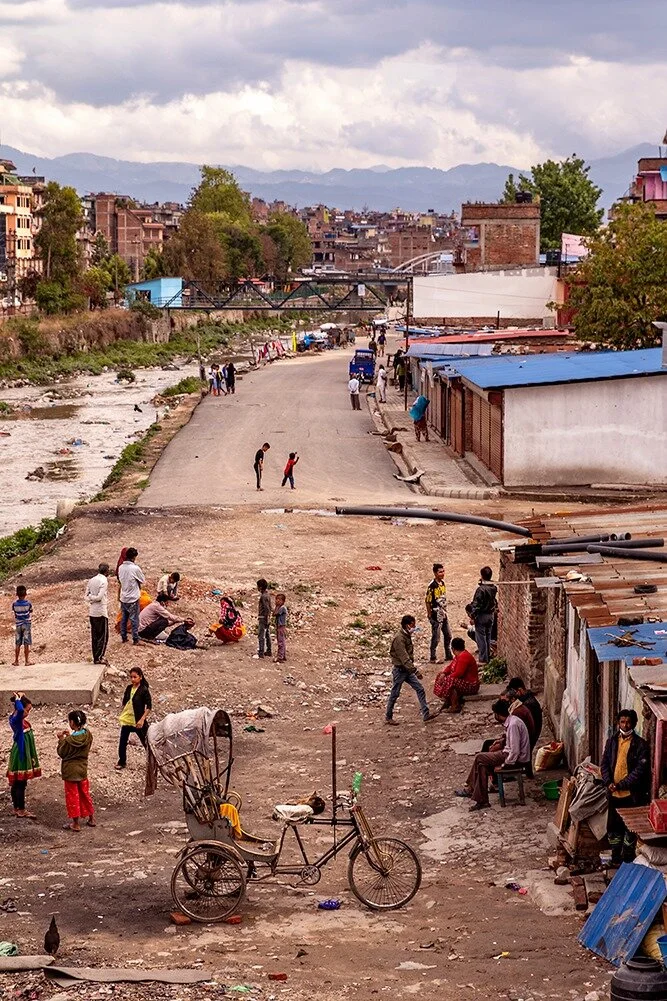
The first thing I see is the slums below the Bishnumati Bridge. A man squatting on a platform by the river cuts his son’s hair while the family gathers around them. The elders sit on benches near an abandoned rickshaw cart. Children play with balls and chickens. Nobody wears a mask. “The beloved river of Vishnu” is now a landfill that the government has commissioned several times to clean up, but no one, not even the police patrolling the bridge above in open trucks, seems to notice the Dalits, the “untouchables,” living in rooms made of corrugated cement sheets. The river acts as a thin boundary between the families confined to the left and people who have been socially isolated for years to the right.

My hotel is far from the usual tourist bustle, so now I have to walk up and down the ubiquitous slopes of this Himalayan city in the afternoon, during the two hours when people are allowed out to buy food, just as the rain begins to pour down. I wear my mountain wind jacket, cover my nose and mouth with the wool balaclava I wear in the mountains, tuck my camera under my arm to protect it from the rain, and carry my rucksack, hoping to fill it with enough food and water for several days.I sometimes duck to avoid the tangled, rain-soaked wires hanging from utility poles and try to remember every pharmacy I pass; they are the only places that are always open and sell water, too. The police officers I encounter along the way wear camouflage uniforms and carry large bamboo batons called lathis, which they use to discourage people from sitting on their doorsteps to chat. They patrol the streets in open trucks and use extendable claws, normally used to recover bodies from the water, to grab and push those defying the lockdown.

Within a couple of weeks, grocery shops are surrounded by stray dogs waiting for the sellers to give them some food. Accustomed to being fed by travelers, they now rest their heads on the sidewalk, too weak to sit. People’s suffering remains hidden indoors, but I will never forget the bewilderment in the animals’ eyes. In Thamel, the tourist hub, the scent of incense and music no longer spills out of the shops and into the streets.On some main roads, piles of rubble accumulate, and construction workers have left behind their rudimentary wooden equipment as if some sudden tragedy had forced them to run for their lives.

Many think the lockdown extension is a way to ensure that no one will celebrate the spring festivals or the New Year. The massive chariot-pulling processions carrying Buddhist and Hindu deities, as well as the tongue-piercing festival, seem too Tantric and visceral for an epidemic, too dangerous; priests therefore perform the pujas alone in the temples.All attention turns to the cremation grounds at Pashupatinath Temple. Although the temple is closed to the public, a rising number of bodies cannot remain hidden for long. The country has seen fewer than ten cases of COVID-19 for almost a month, and we all begin to adapt to one of the strictest lockdowns in the world. But on April 21, newspapers in Kathmandu announce that community transmission has begun after eleven Indians who had crossed the border were found hiding in a mosque in the southern district of Udayapur. Now everybody knows the airports will remain close for months. Evacuation flights stopped weeks ago. I remember the silence at home when I call with the news.

In the Narendra Modi era, the Muslim community has been scapegoated in India, accused of spreading COVID-19 through religious gatherings. Many of the migrant workers who sustain Nepal are denied the right to return and now crowd the border. The improvised quarantine facilities in rural areas are traps where people become infected, and Nepalis confined for a month feel that all their sacrifices have been for nothing. An incompetent government has sealed their fate, so they begin finding their own ways out.

4

SAHEEL IS A 26-YEAR-OLD MADHESI, A MUSLIM NEPALI OF INDIAN HERITAGE, whom I meet in Thamel. He moved from the Terai plains to Kathmandu to work in one of Thamel’s thangka shops. I’m taking photographs there when I hear people whistling to one another. Soon I realize that some men are following me. I instinctively grab my camera; the leather strap is around my neck, and I worry that if they pull on it, they could drag me along the street.

At that moment, Saheel steps forward and introduces himself. He is quick-witted, has crow-black hair, and wears the same cloth mask most people wear in this heavily polluted city. Judging by his eyes, I imagine he has a beautiful face. He asks me if there is anything I need. “Do you know if there are any restaurants open?” I ask. He guides me away from the main streets and into narrow alleys where there is no one. Following a stranger whose face is half-covered through deserted narrow alleys is well beyond my solo travel protocol. I follow him anyway, but slip my hand into my pocket and grip the brass whistle I always carry in the mountains in case of an accident, since I prefer walking alone. He takes me to a pub where only three local men are sitting and asks me what I want to eat. “Whatever you have,” I say, realizing that the pub is officially closed and that he is asking a friend for a favor so we can get something to eat. They both go into the kitchen to discuss it, but Saheel comes back disappointed, saying we’d better find another place.

We talk all the way there, and he takes something resembling a passport from his pocket and shows me a picture of his two-year-old baby inside. I notice the kohl painted around the baby’s eyes, meant to protect children from the evil eye. Saheel tells me he has been out of work for a month in a country with virtually no unemployment safety net and is doing whatever he can to survive. I know what he wants. It is something no one has asked me for since my first trips to Nepal during the final years of the decade-long civil war.

Some Nepalis used to ask foreigners to buy them a can of powdered baby formula that would last a family with one child for a month and cost $17, roughly a week’s salary in Nepal. Most of the time, they would take it back to the store, return it and get the money back.

kathmandu_restaurant_blog.jpg

Saheel takes me to another narrow alley where people, mainly Nepalis, are crowded into lines on both sides. Two Chinese women in hazmat suits guide them to a water drum to wash their hands before going upstairs to sit on a balcony and eat. We ask one of the women if it is possible to pay for the food, but she shakes her head, so I tell Saheel I don’t want to eat there. Before I leave, I turn to take a photo, and an angry man waiting in line turns around and shouts at me not to do it.

I put the camera down, but as soon as he returns to the line, Saheel tells me, “Take the photo, I’m here.” I hesitate for a second, and this time the man strides aggressively toward Saheel. I shout to Saheel that it isn’t worth it, and we leave quickly. But I understand better what people in that alley are feeling the next time I pass by and find several stranded Chinese tourists taking pictures with their cell phones. One of them is using a selfie stick to film himself as he explains why people go there.

We turn around, and I come across a large group of foreigners slowly walking together toward the restaurant. A six-foot-tall man at the front seems to be leading them. There are about 15 of them, all wearing cloth masks and dusty trekking clothes. Since the lockdown began, I haven’t seen any other foreigners, but I know there were 10,000 travelers in the country when it started and that not all of them were able to leave. I’m not surprised by their appearance.They look like ghosts and seem defeated. They came to a poor country as privileged tourists and now depend on the country’s food relief program.

Farther ahead, a man in his sixties approaches Saheel in tears, showing him his injured hand. They speak in Nepali, but Saheel is protective again and tells me to hurry up. He tells me someone has stolen the man’s money and hurt his hand. I ask what happened, but he shrugs. “He is on drugs, you know? Glue.” It seems shop owners used to keep people like him away, but Thamel has a different meaning right now.

Eventually, Saheel has the idea of taking me to a bakery he knows is open. A little farther away, there is another Thamel, one for the locals. In the narrow alleys on its outskirts, women squat elbow to elbow in the street selling vegetables. If what I long for is something warm to eat, the bakery makes small, hard-crust pizzas and heats them in the oven. It is better than nothing. I buy him the baby formula, and at a pharmacy he calls his brother Nakir, who comes to pick me up in his rickshaw. Saheel enters his phone number into my cellphone and tells me he is always in Thamel, trying to survive, and that he will help me with anything I need.

On the ride back to the hotel, Nakir turns around and offers to sell me hashish. It is a typical offer, as Kathmandu still evokes the mystique of the hippie trail in so many ways. I politely refuse and assume Saheel knew he would offer it to me. We are going home at bicycle speed along an empty road, yet I have never gone so fast in a rickshaw. Nothing remains of the chaos that makes South Asian cities what they are. “No cows, uh? No people,” he shouts. The more I laugh with excitement, the more encouraged Nakir becomes to pedal faster.


I meet Saheel again a few days later. This time there are even more men controlling the area and asking me what I am looking for. When I ask for a supermarket, some lead me a few steps farther and knock on a steel rolling door so that someone inside can open it. When I come back out, others approach me. “Do you want shawls, trekking boots, a haircut, didi?” I can see the feet of shop owners beneath partially raised doors, and from time to time I hear repeated whistles traveling along the streets. Sometimes they warn others that the police are coming; at other times, that a new foreigner is looking for something. Rickshaw drivers also follow the few foreigners they see, paradoxically offering tours of deserted places.


Saheel wants me to take photos of what is happening in his country and leads me to the back of the Annapurna Hotel, where about 200 Nepalis are waiting in line for food. On the way there, I see many children. Saheel gestures to one wearing his mask on his chin to pull it up properly. The children don’t seem embarrassed. They walk resolutely with their friends and treat it as an adventure, but I also see some flinch as if they were about to be shot when a police officer points a handheld thermometer at them to take their temperature. A blond Western woman hands out food packages one by one, her hair damp and her surgical gloves slick with sweat. She runs back and forth, looking exhausted, and in less than ten minutes, she shouts, “Finito!” The food is gone; those still waiting will have to come earlier the next day. The line simply dissolves. Without protest, people turn around and go home. Business as usual.

5

SEVEN WEEKS HAVE PASSED SINCE I ARRIVED. From the rooftop, the Himalayan range is visible in the distance for the first time in decades. Every day I wake up before dawn to the sound of Asian koels calling wildly to one another and leave bananas on the balcony for the gray langur monkeys that roam the garden paths before the gatekeeper arrives. I have stopped calculating when I might be able to return home. One evening, I’m sitting on a step of one of the porches overlooking the garden. I’m surrounded by mango trees, weeping willows and star jasmine. The lights along the garden paths are on just for me, and above them are sculptures of dancing Hindu gods and goddesses. Tiny Mera is playing around and, from time to time, she stops and looks at me, like a child checking that a parent is still there. Although I’m used to traveling alone, I had taken an entire safety net for granted until it disappeared overnight. I draw on the skills I learned in the Himalaya: self-confidence, alertness, acceptance. Now I listen to the voice beating inside me. I look around and finally feel it, the sense of awe that had eluded me in the mountains, and I realize I have been happy throughout this journey.

Then an email from the French embassy arrives unexpectedly. They urge me to go to the embassy and get a ticket for one last repatriation flight leaving that Saturday. My first reaction is to delete it without telling anyone, but Spain has already flattened the curve while the worst is still ahead in Nepal. I feel like a freeskier who has been waiting at the top of a mountain for the right second to jump.

I go to Thamel one last time to say goodbye to Saheel. I see the disappointment in his eyes. We can’t shake hands, but instead he pulls his mask down to his chin. Only then do I see the characteristic discoloration around his nose and mouth, his front teeth gone but the roots still there, all the signs I associate with a glue sniffer, someone I would never have dared to talk to. I’m dazed and hurt. Gasping for air, I whisper, “I don’t want to go,” fighting back the tears I have held in for two months. I fear the uncertainty of being stranded in France, I fear getting sick, but most of all, I fear returning to a country that has changed while I was away.

“You’ll be back soon, you’ll see,” Saheel says. I nod with a sad smile he can’t see and wish him the best. Then I turn away and leave.

UPPER MUSTANG: TO THE KINGDOM OF lO

TRAVEL NARRATIVE

Mountain landscape near Tangye. Lo Manthang, Upper Mustang, Nepal

Reaching Tangye, Upper Mustang. ©Vanessa Martín Quintana

10 min read

Excerpt, Part I

THE BOY LOOKS MORE LIKE AN EGYPTIAN GOD THAN A LO-PA. He is a thirteen-year-old monk who wears old trainers with his red robes and keeps his sweatshirt hood up when he takes me inside the Jampa monastery. I have just reached the ancient Kingdom of Lo feeling strong, and that means I have won. There was nothing my two Sherpa friends could say to convince me to follow the usual itinerary and end it here as all the other groups we have met along the way. I felt so much joy when I came close to the city walls that I rushed around them, searching for the northeast corner gate. At one point, the canyon beside the wall narrows sharply. As I lost my footing for a second my attention immediately shifted to the roar of Kali Gandaki River deep below us.

A giant golden Maitreya overlooks the gompa, the future Buddha, the savior one finds in all religions. The light from the open gate reflects off him and leaves the rest in darkness. I turn on my cell phone lantern, and we start circumambullating it to see the wall frescoes. One by one, I illuminate the five great Buddhas and say their names aloud as I pass them; White Vairocana, green Amoghasiddhi, red Amitabha, yellow Ratnasambhava, and blue Akshobhya. Like all Tibetan imagery, they are vestiges of older animistic origins. Each is associated with a cardinal point, an earth element, an animal, a different mudra, a mantra. Their colors reappear in the five prayer flags that flutter in the mountains to fill the wind with their essence. The five skulls on the crowns of wrafthful figures represent the five primary negative emotions, and each of these Buddhas teaches you to neither to struggle against those emotions nor to deny them, but to transform them into skills. The light from my headlamp falls straight upon their faces. I see equanimity in their smiles and intense compassion in their gaze, and it is intimidating to know their meaning. Their laser glare seems to ask me, “Have you done your work yet?”

I see the chalk circles among them, and when I look closer, I realize they are encircling cracks in the walls. “From the earthquake?” I ask. The boy nods sharply. Each time I see one, I ask if I can take a picture hoping that, because we are alone, he might find the forbidden attractive. But these are not children. Lettting me visit the second floor where the Tantric figures are, is out of the question, even for him.

I have to refrain from touching those thin cracks the same way I have restrained myself from placing my hand on the monk's shoulder as we walk. They move me. Nobody has seen the cracks the earthquake made inside me or could imagine why I can still feel them. But they are the main reason I decided I would not postpone coming back, not by a single year.

Novice monk in Lo Manthang, Upper Mustang

Novice monk in Lo Manthang. ©Vanessa Martín Quintana

2

Upper Mustang had been my goal since late 2014, when I first began editing a book titled Mustang: The opened gates to the forbidden Kingdom, a German book about a pioneering journey that took place in 1992 just after the region, a demilitarized zone for almost forty years, opened to the world. The Kingdom of Lo had long retained a degree of local autonomy under Nepal, and its royal title survived until 2008, when Nepal abolished the monarchy and became a federal democratic republic. Although Upper Mustang is culturally Tibetan and geographically part of the Tibetan plateau, the Kingdom had been incorporated into Nepal at the end of the 18th century and fought on Nepal’s side during the Sino-Nepalese War between Tibet and Nepal. The Tibetan culture and identity survive today, while across the border in Tibet they are under intense pressure under Chinese rule.

For centuries, the salt from the great Tibetan lakes and India’s grain and spices made Upper Mustang a prosperous trade center. Caravans on the major trade route moved alongside livestock driven by nomads from the rain shadow country to greener pastures. Not only gompas and stupas but fortress ruins and the walled city of Lo are a testify to its past economic hegemony and its enmity with the neighboring Kingdom of Humla.


Yangsor is a Lama, a clan within the Tamang people. He practices Bön and was born and raised in Humla, a region bordering Tibet, one of Nepal’s the highest, most remote and poorest. We did the Humla-Tibet traverse together twice. Those were my first journeys, and I didn’t not choose the easy way to begin. It was during wartime.


At the airport waiting for our flight to Jomsom, Yangsor is constantly reminding me of how much that traverse has changed under Chinese influence. “Do you remember how excited you were when our small aircraft landed straight into the mountains? Now there is an airstrip and quite a bit of traffic there. Do you remember the Land Rover accident we had when we were driving on the dirt road from Kailash? Now it is all paved. Do you remember the Guge frescoes you wanted to explore? Now the Chinese have built a stairway and sell tickets to get there.” He tries to avoid giving me news about Tibet, although I know the Kailash I traveled to several times no longer exists. Progress is necessary. Life in the Himalaya is extremely hard, but this kind of progress often comes with a disregard for tradition and religion while bringing Tibetans little benefit. Yangsor’s memories remind me how fragile what I am about to experience is. With Tibetan culture under pressure in Tibet, the Dalai Lama has called on Mustang and other ethnically Tibetan Himalayan regions to preserve their way of life. Nevertheless, over the last decade the Nepali government has built a road corridor linking Mustang more closely to China and Nepal’s modern road network. It has brought electricity and a few other conveniences, but I know from traveling to Nepal during some of the most decisive moments of the past 12 years how effective China has been in getting the Nepali government to carry out its policy of control. What I see in Upper Mustang is a crude, unpaved road following the ancient Salt Route footpath. But I have to travel farther, where the canyons have made road building impossible.

On the fifth day, we are slowly ascending a large hillside when I hear a strong rhythmic rumble filling the open air. “What is that?” I ask. A puja ceremony is starting down there. I turn to take one last look at Tsarang Gompa and the fortress ruins surrounding it. On its facade, the white, olive, and ochre painted stripes indicate it belongs to the Sakya tradition of Tibetan Buddhism. For a moment, I think the drumming was coming from the blood pounding in my temples.

This is not an alpine journey but one into a high-altitude desert. The pockets of green from the sparce terraces in Kagbeni remind me of the vineyards growning out of the volcanic soil in the Canary Islands; there too, stone walls surround the crops and protect them from the strong winds, a symbol of perseverance. When we are caught in a sandstorm while climbing the slope opposite the Renchung caves the previous day, I hear Yangsor already at the top shouting to me. Once I’m standing next to him, I recite to myself: I’m from a windy place, and the day I was born, a Sirocco turned the sky completely red with Saharan sand.

Kebi laughs. This region area requires a minimum of two foreign travelers on a permit, and I did everything to make the trip without a group. Just two months before, the Nepali authorities required the company of a certified guide to trek this restricted area. These new rules responded to a blizzard that killed 39 trekkers in 2014 in this Annapurna region, followed by the earthquake disaster a year later. Kebi is not acting as a guide. He has only been to Upper Mustang once before. In the same way, my foreign partner was a woman who wants to travel by motorbike. We share the permit, we are bound together by dates of arrival and departure, but we never meet. When Yangsor introduced me to Kebi in Kathmandu, I could not help but compare the width of our shoulders. Mine were probably twice as broad as his, but he ended up carrying the heavier load, cooking while singing and defending me against condescension as Yangsor cannot help treating me like a Nepali sister.

As with meditation, walking hard for long hours is not always peaceful. In 2005, before my first journey to Tibet, I started practicing meditation at a Meister Eckhart Institute. My mentor was a Catholic priest who would soon be excommunicated for inviting poor people to his church and teaching them Zen meditation. The German theologian whose name the institute had adopted died while proceedings over alleged heresy were still unresolved. Centuries later, his writings would often be compared with Eastern mystical traditions. However, Meister Eckhart is now considered one of the greatest mystics of the Middle Ages. Before we started meditating, the priest had warned us that we would go to places in our minds we would not want to inhabit before we learned to be present. He also told us about a man he meditated with who suddenly stood up, smashed his meditation bench against the wall and never returned.


In Upper Mustang, I have to deal with my anger over things that I link to Nepal and the earthquake. Sometimes I become aware of those thoughts just because I’m swinging my trekking poles violently. Then, I stop, gasping for breath, watch the landscape from a high pass, and remember I’m traveling through the deepest canyon in the world. In Tibetan legends, demons carve these gorges and mountains. Sometimes, I succeed, and the rhythmic pulse from the ceremonial drums fills my mind for hours.


Vanessa Martín Quintana trekking with Kebi Gurung in Upper Mustang, Nepal

On the way with Kebi Gurung. ©Yangsor Lama

We climb the Nyi La pass at 13,000 feet, and from the top, Yangsor points to a huge amphitheater and tells me we are in the land where the Khampa Tibetan resistance hid for decades. Then, he points to the horizon and adds, “the Tibetan border.” We descend the slope skirting the amphitheater, and suddenly the waterless monochromatic landscape becomes a colorful mandala of layered mountains. Most mountains have the shape of arteries spreading in all directions; there are rock pinnacles of a pristine white alongside yellow and gray pillars. Rust-colored sandstone grades into an unreal light blue hue. I have only seen such a combination of colors in volcanic soil. The thin air makes me see the distance so clearly that I can add the snow-capped peaks to this desert vision.

Hours later, in the sunny afternoon, the desert landscape turns into a small oasis where we follow a stream surrounded by a grove of dry golden poplars. We cross a tree-trunk bridge and enter Drakmar. I have an eerie feeling walking through the maze of alleys among the deserted medieval whitewashed houses. Fall leaves blown through as we pass a curious Tibetan mastiff whose sleep we have disturbed, a village fountain with a bucket full of clothes waiting to be wash, and two ponies tied up in the shade. There is nothing else in the hamlet. Then, I raise my head, and above the flat-roofed houses, I see fluted cliffs of an intense red, full of caves. It is difficult to believe that in Upper Mustang, the mountain colors are caused by erosion and not painted by hand, but this time I know a legend that explains it. When the Indian saint Padmasambhava introduced Buddhism to Tibet, he found that a Tibetan demoness had destroyed the foundations of a Buddhist monastery under construction in central Tibet. He pursued the demon west, deep into Mustang, and the two fought in the sky among Mustang’s snow peaks, desert canyons, and grasslands. Padmasambhava prevailed, and he scattered the demoness’ body parts across Mustang. Her blood formed the towering red cliffs, her intestines tumbled onto the wind-scoured earth east of the peaks, and with her red heart he built Ghar Gompa. It is the oldest monastery in Upper Mustang and belongs to the Nyingma traditions.

The same copper red that distinguishes the monasteries from clusters of whitewashed houses colors Drakmar’s fluted mountains as if claiming, “These are the real temples, these are the real schools of Buddhism.”

THE THIN MOUNTAINS ARE CONSTANTLY WALKING

TRAVEL NARRATIVE

 
“There are no mountains like the Himalaya for in them are Kailash and Manasarovar. As the dew is dried up by the morning sun, so are the sins of mankind by the sight of the Himalaya.”
— THE SKANDA PURANA
Nanda Devi and the Sutlej canyon in western Tíbet

Nanda Devi, India’s second-highest mountain, behind the Sutlej Canyon in western Tibet. © Bruno Baumann

10 min read

NOTHING HAS GIVEN HUMANKIND A GREATER SENSE OF DIVINITY THAN MOUNTAINS, and no place can make you more aware of their power than the Himalaya. According to the Vedas, their vision may change your life, and when travelers walk around the crowded city streets or enters temples and hotels throughout Asia, they are unwittingly looking at mountains and finding hidden meanings repeated around them. Such is the Himalaya’s influence that they are at the core of Asian religions shaping Asian cosmology, art, and daily life.

According to the Vishnu Purana, a Hindu myth, the creation of the universe started when Vishnu counseled the gods to seek cooperation with the demons to churn the great ocean together, which would reveal the gems, herbs, and the nectar of immortality they were both seeking. To do so, they uprooted Mt. Mandara. They also summoned the sacred serpent Visuki which wound himself around the mountain as a churning rope. It caused chaos, the water turned into clarified butter and from it, they emerged the sun and the moon, all the sacred elements, animals and gods, the wish-fulfilling jewel, and Mt. Meru, the center of our universe and the beginning of human life.

The legend of Mt. Meru spread to Buddhism through two different systems which explain the universe’s structure. One is derived from the early Abhidharmakosha composed by the Indian Buddhist master Vasubandhu during the 4th-century a. D. The second is called The Kalachakra Tantra, the Wheel of Time, and was introduced to Tibet in a. D. 1024, becoming the highest esoteric teaching in this country.*1


Mt. Meru appeared at the center of the cosmic ocean, and surrounding it, seven concentric rings of golden mountains arose, each separated by an inner sea formed of rainwater, and surrounding these was a vast circular saltwater ocean bounded on its outer circumference by a fence of iron mountains from them came out the four directional continents surrounding Mt. Meru as islands. Paintings of these maps are in the walls of many gompas all over Tibet.


The mountain legend also became part of Asian architecture. The classic Indian temple structure spread throughout Asia; from the temples of Angkor Wat in Cambodia to Mandalay’s ones in Burma, represent Mt. Meru, surrounded by a mountain chain. Therefore, what the travelers see and what they step into, even in the cities, is part of a legend inspired by the Himalaya’s sight.

In Tibet ceremonies, Buddhist monks create Torma; offering cakes made of flour and butter, which convey deities or depict deities on their summit. Tibetans place Tormas in altars to please the gods or to appease wrathful spirits. Later, they consume these mountains, and the leftovers are offered to lower beings after being blessed.

Mt Kailash behind a yak skull in Ngari, Tíbet

Mt. Kailash southern face behind a yak skull carved with a mantra. Ngari prefecture, Tibet. © Bruno Baumann

Four major religions; the Hindus, Buddhist, Jainas, and Bon identified Mt. Meru with Mt. Kailash located in southwest Tibet, in the Transhimalaya. All of them place their deities on its top. On Kailash southern face, the rocks form a carved swastika, a symbol of the Wheel of Dharma in motion. Near the mountaisn shoulder, on that side, you can also see a small mount replica of the giant peak. This is the reason why Hindus believe the Tantric god Shiva and his consort Parvati dwell on its summit. Parvati once asked Shiva to teach him the secrets of the universe. Shiva then, sat her on his lap and instructed her on all the different forms of lovemaking. The image of Parvati on his lap, sometimes with her feet placed on his, is the one of the two lovers who has been more frequently depicted. All the Hindu goddesses are avatars of the primordial feminine principle and source of creation called Shakti and the name of the goddess Parvati comes from Parbata, the Sanskrit word for the mountain. Parvati, who resides at the summit of Mt. Kailash, is the daughter of Himavat, also called Parvat; the personification of the Himalayan mountain range. Her name means ‘She of the mountains,’ and with her mythology, the creation source is again associated to the Himalaya.

Nevertheless, what makes Mt. Kailash the most sacred mountain of all is the fact that it is the source of four of the main rivers of Asia, which flow strictly in all the four cardinal points; the Sutjet (west), Karnali (south), Brahmaputra (east) and the Indus (north).


Regarding symbols, the first eastern sacred one that comes to our minds is the  mandala, A mandala is a cosmic map created to help the practitioner visualize a journey. It is sometimes described as a palace with four cardinal entrances and a throne on which a god and goddess embrace. Mt. Kailash can be understood as a natural mandala, a model for the meditational map. Once more, what these traditions encourage you to stare at and worship is a mountain.


The same happens with the Kalachakra seal, a symbol belonging to one of Tibetan Buddhism’s most complex tantric systems in Tibet. The entire symbolism of the seal is exceptionally complex, containing meaning related to all the Tantric teaching; the external, internal, and secret. The external aspects deal with cosmology, astronomy, and astrology. But the image of the so-called Tenfold Powerful mantra relates to Mt. Meru and its surrounding universe.

The Kalachakra first aphorism is "As it is outside, so it is within the body." The same elements that make up the cosmos explained in the external teachings are placed inside ourselves. As the Axis Mundi, Mt. Meru represents our spinal cord; without that mountain within ourselves, we could neither stand nor walk. Furthermore, there are Hindu Yoga treatises such as the 1899 Yoga manuscript in the Braj Bhasa language that portraits the painting of a man’s chakra system together with a whole pantheon inside him, the different sacred stories of the gods and, of course, entire mountain ranges depicted inside his arms.

This Tantric idea of having the whole cosmos inside one’s body inspires Theravada monks to tattoo in themselves a yantra named the Gao Yord representing Mt. Meru surrounded by its nine peaks. It is part of the Sak Yant tattooing tradition performed in Thailand, Laos, Burma and Cambodia.

Eventually, in the East, not even in the afterlife can’t we avoid the presence of the Himalaya. The Thangka, paintings made into clothing and colored with semi precious stones, often show a deity in their own paradise, emanated from their enlightened mind after they died. The Himalayan range is often part of them as if their mind could not forget them and recreated them, as if they could not leave those mountains behind. The Tibetan most important sage Padmasambhava, the man who in the 8th-century a.D. brought Buddhism from Pakistan to Tibet, formed from his enlightened mind a copper mountain to be his entire paradise.

2

The Axis Mundi, or center of the universe, is a common fixation in a worldwide mythology, Mecca is one of those places. Not surprisingly, it was in a mountain nearby that the Quran was revealed to Muhammad, the prophet. According to the Bible, Moses came down a mountain with the ten commandments. There is also a Greek legend in which Zeus places two eagles at opposite ends of the world and commands them to fly to one another. The place in which they met became the center of the earth. Some say it is Mt. Olympus, where the Greek gods abide. Mt. Fuji was the center of the world for the Japanese, and the landscape poetry and paintings in Japan and China express in images their belief that mountains and rivers are Buddha ancestors. From the siddhas in India to the yamabushi in Japan, most sages gain their supernatural powers in mountain retreats. Thus, Mt. Meru has its expression in every single culture and religion. It has roots that descend to the underworld and is so high that it reaches heaven. Mountains fulfill our desire to transcend our world, and water, life itself, comes from them.

However, any mythology can compare to the one created by those born near the Himalaya. There, mountains become lovers you want to breathe in, become one with.

Mt Gaurishankar in the Rolwaling Himal, Nepal

Mt. Gaurisankar, named after the Hindu goddess Gauri and her consort. The Rolwaling Himal, Nepal. © Bruno Baumann

I have a favorite legend from each religion. The Hindu one regards Lord Krishna. The young god came to earth during the preparations for the annual sacrifices to Indra, the god of thunder and rain. Krishna debated with the villagers about what the Dharma indeed was. Because they were farmers, they should do their duty and concentrate on farming and protecting the cattle, never conducting sacrifices for natural phenomena. The villagers were convinced and did not proceed with the special ceremony, but Indra, not being workshipped as he used to, was angered and flooded the village. Krishna then lifted Mt. Govardhan with one finger and held it up to protect his people and cattle from the rain. Krishna represents the ecstatic devotion, the Bhakti, and he teaches us not to worship the sky for rain but to turn our devotion to the mountains instead, the protective force who is the source of the water we need and gives without asking for anything in return. The Diwali, the most important Hindu festival and a memory of the triumph of light over ignorance, dedicates a day to this legend by celebrating

the mountains.*2


Buddhism, first inpired me to climb when I read about the life of Milarepa, who attained enlightenment in just one lifetime after after withdrawing to mountain caves for intensive yogic practice instead of becoming a monk. Doing so, he embodied the Vajrayana ideal of liberation, the Tibetan Tantric path. Milarepa’s story also reminds me of one of my favorite quotes from the book Meditations by Marcus Aurelius, “Short is the little which remains to thee of life. Live as on a mountain.”


Paul Theroux once said, a tourist is someone who doesn’t know where he has been. I grew up surrounded by amazing mountains, but Canary Islanders like me belong to a culture far more connected to the sea. I was lucky to take South Indian studies in college, and it made me dream about it for years until I left it all to travel the Humla-Tibet traverse. Only when I came back from that journey, I noticed the mountain ranges on the island and revered them. But what happens to those who remain insensitive to the Himalaya and blind to the hidden messages? Well, there is hope if they seek guides who have spent their lives among them. The people who make the mountains into food and eat them, turn into speech and chant them or carve to feel enveloped by them, the ones who earn their living in the mountains; the Sherpa.

These are people who burn juniper incense as an offering to the mountains not only before a climb, but as long as anyone remains up there, which beyond worship is an exercise in caring about others. After the earthquake in 2015, some climbers in Everest described how everyone crouched in fear when the earth started shaking, they all waited helplessly listening to the earth roaring and with it, the loud mantras the sherpa were chanting to appease the mountain. Their beliefs and way of life are made of all these stories and rituals, and the greatest gift for those guided by the Sherpa is this sacramental way of living.

We only need to travel to the Himalaya once to feel how the mountains and even the thin air have shaped their beliefs and spirituality. Only the insensitive would fail to respect their environment, or learn their teachings, or would climb their mountains simply to cross them off from a bucket list.

A Western story goes that after the first Everest summit, Tenzing Norgay looked up, and shouted full of gratitude, “Thank you, Chomolungma!” while Edmund Hillary words afterward, on the decent, were “We knocked that bastard off!”

Choose the one you prefer to be, and then climb.


The title is inspired by the Mountains and Waters Sutra, a 13th-century essay by Dōgen included in the Treasury of the True Dharma Eye, where mountains and rivers are explored as expressions of Buddhist teaching and practice.

1-2 The encyclopedia of Tibetan symbols and motifs by Robert Beer